Hay sobre todo dos escalas de temperatura que se usan en el mundo: la escala Fahrenheit (usada en EEUU), y la escala Celsius (parte del Sistema Métrico, usada en casi todos los demás países)
Las dos valen para medir lo mismo (¡temperatura!), sólo con números diferentes.
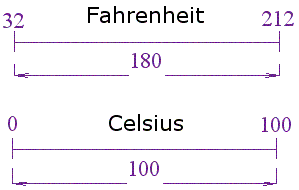
- Si congelas agua, la escala Celsius marca 0°, pero la Fahrenheit marca 32°.
- Si hierves agua, la escala Celsius marca 100°, pero la Fahrenheit marca 212°.
- La diferencia entre congelar y hervir agua es 100° Celsius, pero 180° Fahrenheit.
| Congelar | ... o ... | Hervir |
|---|---|---|
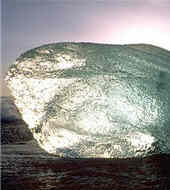 |  | 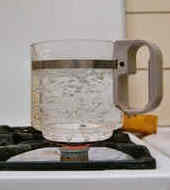 |
Método de conversión
Mirando el diagrama vemos que:
- Las escalas empiezan con valores diferentes (32 y 0), así que tendremos que sumar o restar 32
- Las escalas suben a diferente ritmo (180 y 100), así que también necesitamos multiplicar
Y así funciona:
| Para convertir de Celsius a Fahrenheit, primero multiplica por 180/100, después suma 32 |
| Para convertir de Fahrenheit a Celsius, primero resta 32, después multiplica por 100/180 |
Nota: si simplificas 180/100 queda 9/5, y de la misma manera 100/180=5/9.
Así que la manera más fácil es:| Celsius a Fahrenheit | (°C × 9/5) + 32 = °F |
| Fahrenheit a Celsius | (°F - 32) x 5/9 = °C |
Ejemplo 1
Convierte 26° Celsius (¡un día caluroso!) a Fahrenheit
Primero: 26° × 9/5 = 234/5 = 46.8
Después: 46.8 + 32 = 78.8° F
Después: 46.8 + 32 = 78.8° F
Ejemplo 2
Convierte 98.6° Fahrenheit (¡temperatura corporal normal!) a Celsius
Primero: 98.6° - 32 = 66.6
Después: 66.6× 5/9 = 333/9 = 37° C
Después: 66.6× 5/9 = 333/9 = 37° C
Temperaturas más comunes
| °C | °F | Descripción |
|---|---|---|
| 100 | 212 | El agua hierve |
| 40 | 104 | Un baño caliente |
| 37 | 98.6 | Temperatura corporal |
| 30 | 86 | Tiempo de playa |
| 21 | 70 | Temperatura en una habitación |
| 10 | 50 | Día fresco |
| 0 | 32 | Punto de congelación del agua |
| -18 | 0 | Día muy frío |
| -40 | -40 | Día extremadamente frío (¡y el mismo número en las dos escalas!) |
| (los valores en negrita son exactos) There are primarily two temperature scales used in the world: the Fahrenheit scale (used in USA), and the Celsius scale (part of the Metric System, used in most other countries) Both are worth to measure the same (temperature!), Only with different numbers. • If you freeze water, 0 ° Celsius mark, but the mark 32 ° Fahrenheit. • If you boil water, the scale reads 100 ° Celsius, but 212 ° Fahrenheit mark. • The difference between freezing and boiling water is 100 ° Celsius, but 180 ° Fahrenheit. Freeze ... or ... Boil Conversion method Looking at the diagram we see that: • The scales start with different values (32 and 0), so we have to add or subtract 32 • Scales up at different rates (180 and 100), so we also need to multiply How it works: To convert from Celsius to Fahrenheit, first multiply by 180/100, then add 32 To convert from Fahrenheit to Celsius, first subtract 32, then multiply by 100/180 Note: If you simplify 180/100 is 9/5, and in the same way 100/180 = 5/9. So the easiest way is: Celsius to Fahrenheit (° C × 9/5) + 32 = ° F Fahrenheit to Celsius (° F - 32) x 5/9 = ° C Example 1 Convert 26 ° Celsius (a hot day!) To Fahrenheit First: 26 ° × 9/5 = 234/5 = 46.8 Next: 46.8 + 32 = 78.8 ° F Example 2 Convert 98.6 degrees Fahrenheit (normal body temperature!) To Celsius First: 98.6 ° - 32 = 66.6 Next: 66.6 × 5/9 = 333/9 = 37 ° C Temperatures most common ° C ° F Description 100 212 Water boils 40 104 A hot bath 37 98.6 Body temperature 30 86 Beach time 21 70 Room temperature 10 50 Cool day 0 32 Freezing point of water -18 0 Very cold day -40 -40 Extremely cold day (and the same number on both scales!) (Values in bold are exact) | ||

bien publicado
ResponderEliminargracias compañero
ResponderEliminar